


Page 47 - CA Inter Audit PARAM
P. 47
CA Ravi Taori
                 Discuss the types of inherent, control and detection risks as perceived by the auditor.
          Answer


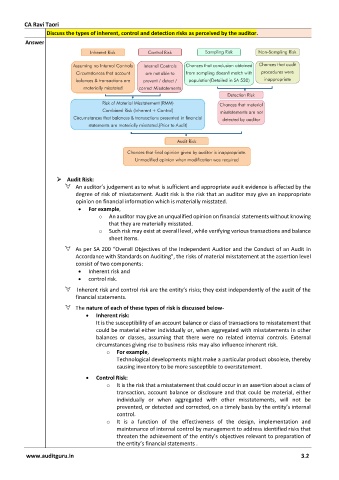
                     ➢  Audit Risk:
                            An auditor’s judgement as to what is sufficient and appropriate audit evidence is affected by the
                            degree of risk of misstatement. Audit risk is the risk that an auditor may give an inappropriate
                            opinion on financial information which is materially misstated.
                             •  For example,
                                    o  An auditor may give an unqualified opinion on financial statements without knowing
                                       that they are materially misstated.
                                    o  Such risk may exist at overall level, while verifying various transactions and balance
                                       sheet items.

                            As per SA 200 “Overall Objectives of the Independent Auditor and the Conduct of an Audit in
                            Accordance with Standards on Auditing”, the risks of material misstatement at the assertion level
                            consist of two components:
                             •  Inherent risk and
                             •  control risk.

                             Inherent risk and control risk are the entity’s risks; they exist independently of the audit of the
                            financial statements.

                            The nature of each of these types of risk is discussed below-
                               •  Inherent risk:
                                   It is the susceptibility of an account balance or class of transactions to misstatement that
                                   could be material either individually or, when aggregated with misstatements in other
                                   balances  or  classes,  assuming  that  there  were  no  related  internal  controls.  External
                                   circumstances giving rise to business risks may also influence inherent risk.
                                      o  For example,
                                          Technological developments might make a particular product obsolete, thereby
                                          causing inventory to be more susceptible to overstatement.

                               •  Control Risk:
                                      o  It is the risk that a misstatement that could occur in an assertion about a class of
                                          transaction, account balance  or disclosure and that could be material, either
                                          individually  or  when  aggregated  with  other  misstatements,  will  not  be
                                          prevented, or detected and corrected, on a timely basis by the entity’s internal
                                          control.
                                      o  It  is  a  function  of  the  effectiveness  of  the  design,  implementation  and
                                          maintenance of internal control by management to address identified risks that
                                          threaten the achievement of the entity’s objectives relevant to preparation of
                                          the entity’s financial statements .
           www.auditguru.in                                                                                                                      3.2

