


Page 82 - CA Inter Bhaskar Vol 1
P. 82
RISK ASSESSMENT AND INTERNAL CONTROL                                           CA RAVI TAORI


                               2. Regulatory Environment
                                  Understand the applicable financial reporting framework and industry-specific accounting
                                  practices.
                                  Review laws and regulations significantly affecting the entity’s operations, including taxation
                                  and direct regulatory supervision.
                                  Consider the impact of government policies and environmental regulations relevant to the   AUDIT BHASKAR CH 03 - PART 01
                                  entity’s business and industry.


                               3. Other External Factors
                                   Analyse economic conditions, such as GDP trends, inflation, and market volatility.
                                   Assess interest rates and availability of financing, which may influence the entity’s financial
                                   risk and decision-making.


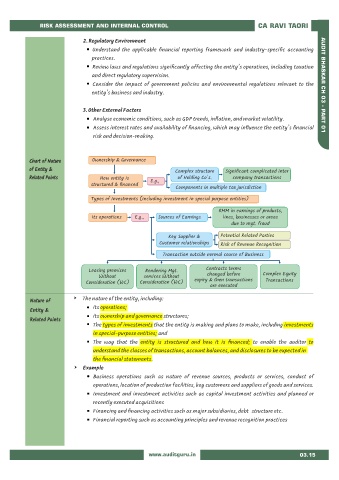
            Chart of Nature       Ownership & Governance
            of Entity &                                         Complex structure   Significant complicated inter
            Related Points           How entity is     E.g.,     of Holding Co's.    company transactions
                                  structured & financed
                                                                Components in multiple tax jurisdiction
                                  Types of Investments (Including investment in special purpose entities)

                                                                                RMM in earnings of products,
                                  Its operations  E.g.,   Sources of Earnings     lines, businesses or areas
                                                                                     due to mgt. fraud

                                                              Key Supplier &     Potential Related Parties
                                                           Customer relationships  Risk of Revenue Recognition

                                                            Transaction outside normal course of Business

                                                                           Contracts terms
                                 Leasing premises    Rendering Mgt.
                                     Without         services Without       changed before      Complex Equity
                                Consideration (WC)  Consideration (WC)  expiry & then transactions   Transactions
                                                                             are executed

            Nature of          The nature of the entity, including:
                                   its operations;
            Entity &
                                   its ownership and governance structures;
            Related Points
                                   The types of investments that the entity is making and plans to make, including investments
                                   in special-purpose entities; and
                                   The  way  that  the  entity  is  structured  and  how  it  is  financed;  to  enable  the  auditor  to
                                   understand the classes of transactions, account balances, and disclosures to be expected in
                                   the financial statements.
                               Example
                                   Business  operations  such  as  nature  of  revenue  sources,  products  or  services,  conduct  of
                                   operations, location of production facilities, key customers and suppliers of goods and services.
                                   Investment and investment activities such as capital investment activities and planned or
                                   recently executed acquisitions
                                   Financing and financing activities such as major subsidiaries, debt  structure etc.
                                   Financial reporting such as accounting principles and revenue recognition practices


                                                       www.auditguru.in                                      03.15

