


Page 84 - CA Inter Bhaskar Vol 1
P. 84
RISK ASSESSMENT AND INTERNAL CONTROL                                           CA RAVI TAORI


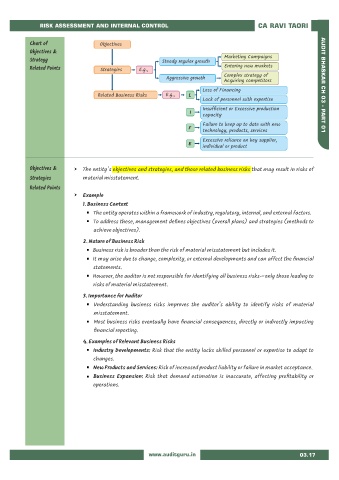
            Chart of                 Objectives
            Objectives &
                                                                                  Marketing Campaigns
            Strategy                                        Steady regular growth
            Related Points           Strategies    E.g.,                          Entering new markets
                                                                                  Complex strategy of
                                                             Aggressive growth
                                                                                  Acquiring competitors              AUDIT BHASKAR CH 03 - PART 01
                                                                          Loss of Financing
                                    Related Business Risks   E.g.,   L
                                                                          Lack of personnel with expertise
                                                                          Insufficient or Excessive production
                                                                     I
                                                                          capacity
                                                                          Failure to keep up to date with new
                                                                     F
                                                                          technology, products, services
                                                                          Excessive reliance on key supplier,
                                                                     E
                                                                          individual or product


            Objectives &       The entity's objectives and strategies, and those related business risks that may result in risks of

            Strategies         material misstatement.
            Related Points
                               Example
                               1. Business Context
                                   The entity operates within a framework of industry, regulatory, internal, and external factors.
                                   To address these, management defines objectives (overall plans) and strategies (methods to
                                   achieve objectives).

                               2. Nature of Business Risk
                                   Business risk is broader than the risk of material misstatement but includes it.
                                   It may arise due to change, complexity, or external developments and can affect the financial
                                   statements.
                                   However, the auditor is not responsible for identifying all business risks—only those leading to
                                   risks of material misstatement.
                               3. Importance for Auditor
                                   Understanding business risks improves the auditor’s ability to identify risks of material
                                   misstatement.
                                   Most business risks eventually have financial consequences, directly or indirectly impacting
                                   financial reporting.
                               4. Examples of Relevant Business Risks
                                   Industry Developments: Risk that the entity lacks skilled personnel or expertise to adapt to
                                   changes.
                                   New Products and Services: Risk of increased product liability or failure in market acceptance.
                                   Business Expansion: Risk that demand estimation is inaccurate, affecting profitability or
                                   operations.


                                                       www.auditguru.in                                      03.17

