


Page 85 - CA Inter Bhaskar Vol 1
P. 85
CA RAVI TAORI           It is a continuous process as we get exposed to entity, its environment, its document
                                                                 RISK ASSESSMENT AND INTERNAL CONTROL
       AUDIT BHASKAR CH 03 - PART 01   on continuous basis. So we gather, update & analyze information for the audit
                                                                                                (QNO-315.09)
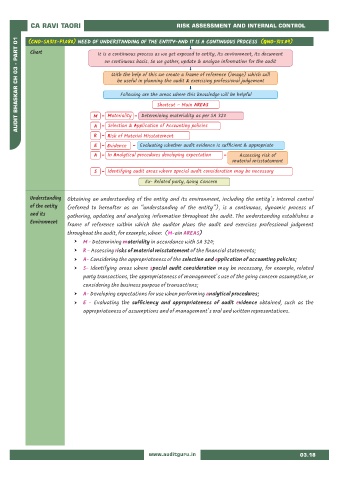
           (CNO-SA315-P1.080) NEED OF UNDERSTANDING OF THE ENTITY-AND IT IS A CONTINUOUS PROCESS
            Chart


                                         With the help of this we create a frame of reference (image) which will
                                           be useful in planning the audit & exercising professional judgement

                                             Following are the areas where this knowledge will be helpful
                                                          Shortcut – Main AREAS

                                   M
                                        Selection & Application of Accounting policies
                                   A
                                   R    Materiality  Determining materiality as per SA 320
                                        Risk of Material Misstatement
                                   E    Evidence   Evaluating whether audit evidence is sufficient & appropriate
                                   A    In Analytical procedures developing expectation  Assessing risk of
                                                                                     material misstatement
                                   S    Identifying audit areas where special audit consideration may be necessary
                                                     Ex- Related party, Going Concern


            Understanding  Obtaining an understanding of the entity and its environment, including the entity's internal control
            of the entity   (referred  to  hereafter  as  an  “understanding  of  the  entity”),  is  a  continuous,  dynamic  process  of
            and its      gathering, updating and analysing information throughout the audit. The understanding establishes a
            Environment
                         frame  of  reference  within  which  the  auditor  plans  the  audit  and  exercises  professional  judgment
                         throughout the audit, for example, when:  ( -ain M  AREAS )
                               M - Determining  materiality in accordance with SA 320;
                               R - Assessing  risks of material misstatement of the financial statements;
                               A- Considering the appropriateness of the selection and  application of accounting policies;
                               S- Identifying areas where  special audit consideration may be necessary, for example, related
                               party transactions, the appropriateness of management's use of the going concern assumption, or
                               considering the business purpose of transactions;
                               A- Developing expectations for use when performing  analytical procedures;
                               E - Evaluating the sufficiency and appropriateness of audit  evidence obtained, such as the
                               appropriateness of assumptions and of management's oral and written representations.


                                                       www.auditguru.in                                      03.18

