


Page 71 - CA Inter Bhaskar Vol 1
P. 71
CA RAVI TAORI                                   CONTROL RISK (CR)
                                                                 RISK ASSESSMENT AND INTERNAL CONTROL
       AUDIT BHASKAR CH 03 - PART 01  Definition   Ineffective   Implementation
            Chart of
            Control Risk
                                                   Controls not able to prevent, detect & correct (PDC)
                                                   Material misstatements individually or in aggregate

                                                   In assertion of TBD
                                                                 Design
                                      Reasons
                                                              Maintenance
                                                   Can reduce it but not eliminate
                                     Elimination
                                                             Top Level    Mgt Override
                                                  Because
                                                               Mid-Level   Collusion
                                                             Lower Level  Human Error
                                  Assessment    Separate or Combined   Quantitative or Non-Quantitative
                                                                            Separate      IR
                                                    Big Client  Good ICS                          RMM
                                                                           Assessment     CR

                                                                 Not having properly   Combined
                                                    Small Client                                   RMM
                                                                   documented ICS    assessment
                                  Inverse Relationship  With efficiency of control


           Control Risk        Definition
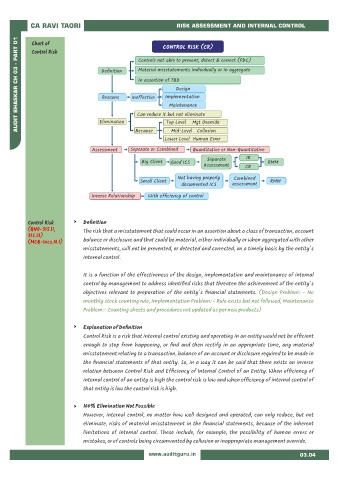
           (QNO-315.11,        The risk that a misstatement that could occur in an assertion about a class of transaction, account
           315.13)
           (MCQ-Incs.10.1)     balance or disclosure and that could be material, either individually or when aggregated with other
                               misstatements, will not be prevented, or detected and corrected, on a timely basis by the entity's
                               internal control.


                               It is a function of the effectiveness of the design, implementation and maintenance of internal
                               control by management to address identified risks that threaten the achievement of the entity's
                               objectives relevant to preparation of the entity's financial statements. (Design Problem: - No
                               monthly stock counting rule, Implementation Problem: - Rule exists but not followed, Maintenance
                               Problem:- Counting sheets and procedures not updated as per new products)


                               Explanation of Definition
                               Control Risk is a risk that internal control existing and operating in an entity would not be efficient
                               enough to stop from happening, or find and then rectify in an appropriate time, any material
                               misstatement relating to a transaction, balance of an account or disclosure required to be made in
                               the financial statements of that entity. So, in a way it can be said that there exists an inverse
                               relation between Control Risk and Efficiency of Internal Control of an Entity. When efficiency of
                               internal control of an entity is high the control risk is low and when efficiency of internal control of
                               that entity is low the control risk is high.


                               100% Elimination Not Possible
                               However, internal control, no matter how well designed and operated, can only reduce, but not
                               eliminate, risks of material misstatement in the financial statements, because of the inherent
                               limitations of internal control. These include, for example, the possibility of human errors or
                               mistakes, or of controls being circumvented by collusion or inappropriate management override.

                                                       www.auditguru.in                                      03.04

