


Page 74 - CA Inter Bhaskar Vol 1
P. 74
RISK ASSESSMENT AND INTERNAL CONTROL                                           CA RAVI TAORI


            Detection Risk     Meaning: -
           (MCQ-315.10)        The risk that the procedures performed by the auditor to reduce audit risk to an acceptably low
                               level will not detect a misstatement that exists and that could be material, either individually or
                               when aggregated with other misstatements.
                               Suppose auditor of a company uses certain audit procedures for the purpose of obtaining audit
                               evidence and reducing audit risk, but still there will remain a risk that audit procedures used by the
                               auditor may not be able to detect a misstatement which by nature is material, then that risk is   AUDIT BHASKAR CH 03 - PART 01
                               known as Detection Risk.

                               Example
                               While auditing the books of accounts of Grateful Limited for the financial year 2020-21, the
                               auditor of the above mentioned company used various audit procedures, for example-observation,
                               inspection, reperformance, recalculation etc for obtaining audit evidence regarding stock, Debtors,
                               sales, purchases etc., and consequently reducing the audit risk. However, there will always remain
                               a risk that various audit procedures as used by auditor of Grateful Limited will not be able to detect
                               misstatements which are material in nature. This risk is known as Detection Risk.


                               Interrelationship of the components of audit risk:
                               Inherent and control risks differ from detection risk in that they exist independently of an audit of
                               financial information. Inherent and control risks are functions of the entity's business and its
                               environment and the nature of the account balances or classes of transactions, regardless of
                               whether an audit is conducted.


                               Even though inherent and control risks cannot be controlled by the auditor, the auditor can assess
                               them and design his substantive procedures to produce an acceptable level of detection risk,
                               thereby reducing audit risk to an acceptably low level.


                               For a given level of audit risk, the acceptable level of detection risk bears an inverse relationship to
                               the assessed risks of material misstatement at the assertion level. For example, the greater the
                               risks of material misstatement the auditor believes exists, the less the detection risk that can be
                               accepted and, accordingly, the more persuasive the audit evidence required by the auditor.


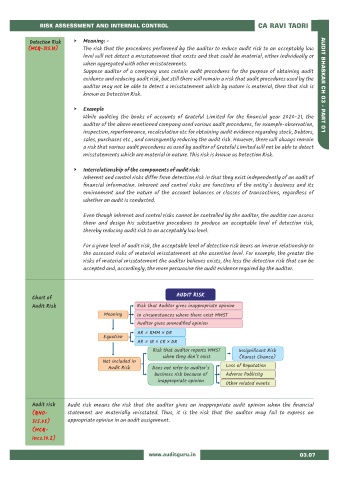
                                                                 AUDIT RISK
             Chart of
             Audit Risk                            Risk that Auditor gives inappropriate opinion
                                       Meaning     In circumstances where there exist MMST
                                                   Auditor gives unmodified opinion
                                                   AR = RMM × DR
                                      Equation
                                                   AR = IR × CR × DR
                                                        Risk that auditor reports MMST   Insignificant Risk
                                                            when they don't exist      (Rarest Chance)
                                      Not included in
                                                                                   Loss of Reputation
                                        Audit Risk      Does not refer to auditor's
                                                         business risk because of   Adverse Publicity
                                                          inappropriate opinion
                                                                                   Other related events


             Audit risk  Audit risk means the risk that the auditor gives an inappropriate audit opinion when the financial
             (QNO-       statement  are  materially  misstated.  Thus,  it  is  the  risk  that  the  auditor  may  fail  to  express  an
             315.05)     appropriate opinion in an audit assignment.
             (MCQ-
             Incs.10.2)


                                                       www.auditguru.in                                      03.07

