


Page 76 - CA Inter Bhaskar Vol 1
P. 76
RISK ASSESSMENT AND INTERNAL CONTROL                                           CA RAVI TAORI


                            1.    Few examples of inherent risks could include: -
                                   Complex Accounting Guidance: An accounting standard provides guidance on some complex
                                   issue which might not be understood by the management. Therefore, recording of this issue in
                                   financial statements carries inherent risk of being misstated.
                                   Industry  Business  Failures:  There  are  large  number  of  business  failures  in  an  industry.
                                   Therefore, assertions in financial statements of an entity operating in such an industry carry   AUDIT BHASKAR CH 03 - PART 01
                                   an inherent risk of being misstated.

                            2.   Examples of control risk could include: -
                                   Locked Safe Control: A company has devised control that cash and cheque books should be
                                   kept in a locked safe and access is granted to authorized personnel only. There is risk that
                                   control is not being followed.
                                   Fire Safety Measures: An entity has devised a control that fire extinguishers and smoke
                                   detectors are in place and are in working condition at all times to reduce the risk of damage to
                                   inventories caused by fire. There is a risk that fire extinguishers in place are expired and are not
                                   being refilled.
                                   Smoke Detector Compliance: Similarly, there is a possibility that smoke detectors are not
                                   working.
                                   Petty Cash System: A company has devised a control relating to petty cash that items of
                                   expenditure of only less than ` 10000 should be routed through imprest system of petty cash.
                                   There is a risk that control is not being followed.


                            3.   Examples of detection risk could include: -
                                   Inventory Audit Practices: Sizeable work-in-progress inventories are expected in financial
                                   statements,  but  the  auditor  does  not  attend  inventory  counts,  opting  for  alternative
                                   procedures.
                                   Revenue Sampling Risks: The auditor audits company revenue by sampling, with the risk that
                                   the sample may not reflect the total revenue accurately.


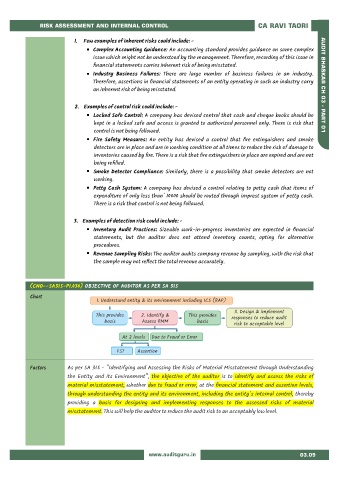
            (CNO--SA315-P1.030) OBJECTIVE OF AUDITOR AS PER SA 315
            Chart
                                    1. Understand entity & its environment including ICS (RAP)

                                                                                      3. Design & implement
                                    This provides   2. Identify &    This provides   responses to reduce audit
                                       basis        Assess RMM          basis
                                                                                      risk to acceptable level
                                             At 2 levels  Due to Fraud or Error

                                           FST     Assertion


            Factors      As per SA 315 - “Identifying and Assessing the Risks of Material Misstatement through Understanding
                         the Entity and its Environment”, the objective of the auditor is to identify and assess the risks of
                         material misstatement, whether due to fraud or error, at the financial statement and assertion levels,
                         through understanding the entity and its environment, including the entity's internal control, thereby
                         providing  a  basis  for  designing  and  implementing  responses  to  the  assessed  risks  of  material
                         misstatement. This will help the auditor to reduce the audit risk to an acceptably low level.


                                                       www.auditguru.in                                      03.09

