


Page 89 - CA Inter Bhaskar Vol 1
P. 89
CA RAVI TAORI              N     Negative Assertion   RISK ASSESSMENT AND INTERNAL CONTROL

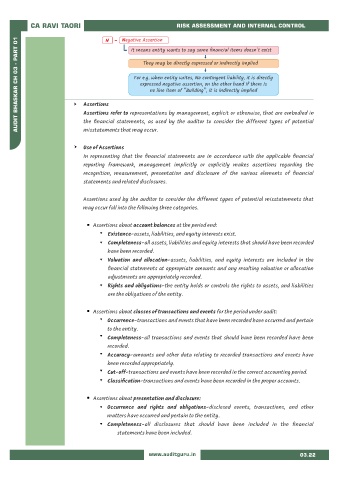
       AUDIT BHASKAR CH 03 - PART 01  Assertions  For e.g. when entity writes, No contingent liability, it is directly

                                                It means entity wants to say some financial items doesn't exist

                                                     They may be directly expressed or indirectly implied


                                                    expressed negative assertion, on the other hand if there is
                                                       no line item of “Building”, it is indirectly implied


                               Assertions refer to representations by management, explicit or otherwise, that are embodied in
                               the financial statements, as used by the auditor to consider the different types of potential
                               misstatements that may occur.


                               Use of Assertions
                               In representing that the financial statements are in accordance with the applicable financial
                               reporting  framework,  management  implicitly  or  explicitly  makes  assertions  regarding  the
                               recognition,  measurement,  presentation  and  disclosure  of  the  various  elements  of  financial
                               statements and related disclosures.


                               Assertions used by the auditor to consider the different types of potential misstatements that
                               may occur fall into the following three categories.


                                   Assertions about account balances at the period end:
                                        Existence-assets, liabilities, and equity interests exist.
                                        Completeness-all assets, liabilities and equity interests that should have been recorded
                                        have been recorded.
                                        Valuation and allocation-assets, liabilities, and equity interests are included in the
                                        financial statements at appropriate amounts and any resulting valuation or allocation
                                        adjustments are appropriately recorded.
                                        Rights and obligations-the entity holds or controls the rights to assets, and liabilities
                                        are the obligations of the entity.


                                   Assertions about classes of transactions and events for the period under audit:
                                        Occurrence-transactions and events that have been recorded have occurred and pertain
                                        to the entity.
                                        Completeness-all transactions and events that should have been recorded have been
                                        recorded.
                                        Accuracy-amounts and other data relating to recorded transactions and events have
                                        been recorded appropriately.
                                        Cut-off-transactions and events have been recorded in the correct accounting period.
                                        Classification-transactions and events have been recorded in the proper accounts.


                                   Assertions about presentation and disclosure:
                                        Occurrence  and  rights  and  obligations-disclosed  events,  transactions,  and  other
                                        matters have occurred and pertain to the entity.
                                        Completeness-all  disclosures  that  should  have  been  included  in  the  financial
                                           statements have been included.


                                                       www.auditguru.in                                      03.22

